How to Choose the Best Beet Root Juice Powder?
Choosing the best Beet Root Juice Powder requires more than comparing bright color and low prices. Product quality depends on beet variety, growing conditions, processing temperature, nitrate content, and storage. That sounds simple, but it is not. Powders can look identical while offering very different nutritional profiles.
Industry data shows why careful selection matters. Grand View Research valued the global dietary supplements market at approximately USD 177.5 billion in 2023, with continued growth expected through 2030. This expansion has increased ingredient choices, but it also makes label comparison more important. The Council for Responsible Nutrition has repeatedly emphasized transparent labeling, responsible manufacturing, and consumer trust. These principles apply directly to Beet Root Juice Powder.
Scientific evidence also needs careful interpretation. The Australian Institute of Sport classifies dietary nitrate as a supplement with potential performance benefits, particularly for selected endurance activities. However, results depend on nitrate dose, timing, fitness level, and individual response. A beet powder’s serving size alone does not prove effectiveness. Look for declared nitrate levels, not only “beetroot equivalent” weight. Check whether the product includes third-party testing, allergen information, country of origin, and a clear lot number.
Color can be a useful clue. A fresh powder should appear naturally deep red or purple, not strangely neon. Yet appearance is not proof. I would also question products making disease-treatment claims or promising instant results. One practical weakness remains: many market reports track supplements broadly, rather than Beet Root Juice Powder specifically. Therefore, reliable choices should combine report data, laboratory documentation, and realistic personal expectations.
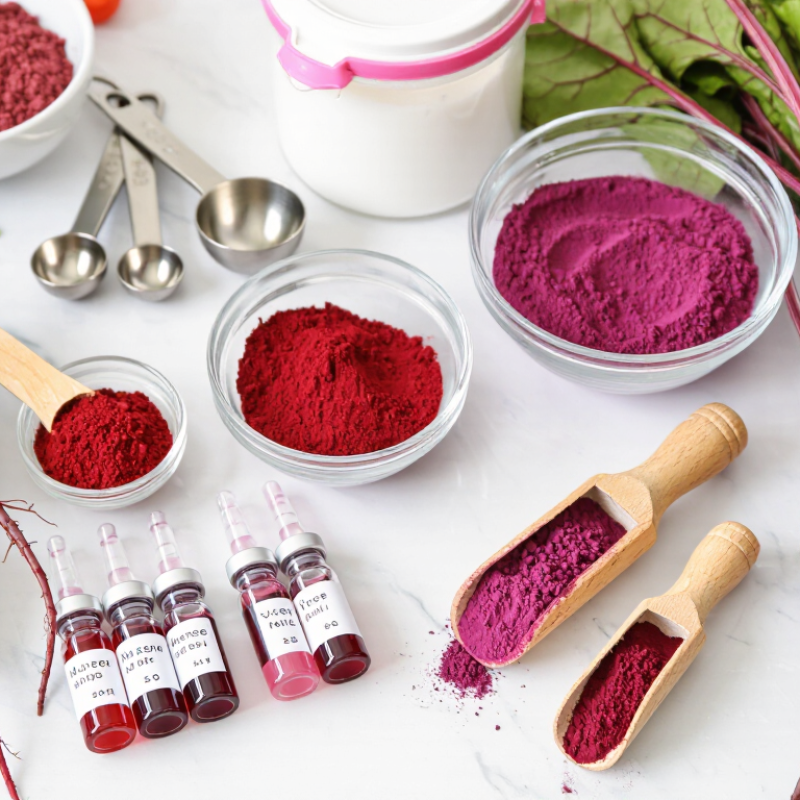
Define Beetroot Juice Powder: Root Powder, Juice Powder, or Extract
Beetroot juice powder is often confused with root powder or extract, but these ingredients behave differently. Root powder is made by drying and milling the whole beetroot. It usually contains natural fiber, pigments, sugars, and minerals. Its texture can feel earthy and gritty.
Juice powder begins with pressed beet juice. The liquid is concentrated and dried, often with a small amount of a carrier ingredient. It dissolves more easily and suits drink mixes. However, its nutritional profile depends on how much pulp was removed. Juice powder may contain less fiber than whole-root powder. Labels can mislead.
An extract is more concentrated than either powder. Manufacturers use water or another permitted solvent to collect selected compounds. The label should identify the extraction ratio, solvent, and standardized markers. A high ratio does not automatically mean better quality. It may simply reflect processing concentration.
When choosing a product, match the ingredient to your purpose. Select root powder for broader whole-food characteristics. Choose juice powder for smoother mixing and a cleaner mouthfeel. Consider extract only when its specifications are clear. Ask for testing data covering nitrate content, moisture, microbes, heavy metals, and pesticide residues. Read the specification.
Color alone proves little. Deep red powder can still vary in strength. Storage also matters, because heat, light, and moisture can reduce quality. The distinction is not always perfectly clean, and some products use overlapping terms. That deserves careful checking.
Compare Nitrate Levels with the 5–8 mmol (310–496 mg) Serving Range
Choosing beetroot juice powder starts with nitrate, not color, sweetness, or serving size. The useful comparison range is 5–8 mmol of nitrate, equal to approximately 310–496 mg. This conversion uses nitrate’s molecular weight of 62.0 mg per mmol. A powder serving may weigh several grams, yet contain far less nitrate than expected. Check the declared nitrate amount per serving.
Research commonly uses doses near this range. A study in the Journal of Applied Physiology used about 6.2 mmol before exercise, while the International Olympic Committee’s 2018 consensus described dietary nitrate as a potentially useful performance supplement. These findings support comparison, not automatic guarantees. Results can vary with training status, diet, timing, and individual nitrate metabolism.
Look for independent laboratory testing, a clear batch number, and results reported in milligrams or millimoles of nitrate. “Equivalent to beetroot” is too vague. The European Food Safety Authority lists an acceptable daily intake of 3.7 mg nitrate per kilogram of body weight from all dietary sources, so total intake still deserves attention. I would also question products reporting unusually precise benefits without human trial evidence. More nitrate is not always better. Labels can be confusing, and even careful buyers may compare beetroot powder weight instead of nitrate content. That is an easy mistake.
How to Choose the Best Beet Root Juice Powder? - Compare Nitrate Levels with the 5–8 mmol (310–496 mg) Serving Range
Use the nitrate amount rather than powder weight alone when comparing beet root juice powders. The calculations below use the molecular weight of nitrate (NO3−): 1 mmol nitrate = 62.0 mg nitrate.
| Example Nitrate Amount per Serving | Equivalent Nitrate Amount | Position Relative to the 5–8 mmol Target | What the Label Indicates | Selection Guidance |
| 250 mg nitrate | Approximately 4.03 mmol | Below target | The serving provides less than 5 mmol of nitrate. | Choose a larger serving only if the product directions and your healthcare professional allow it. |
| 310 mg nitrate | 5.00 mmol | Lower end of target | Meets the lower boundary of the 5–8 mmol range. | A suitable option when you want to reach the target with the smallest stated nitrate amount. |
| 350 mg nitrate | Approximately 5.65 mmol | Within target | Provides a moderate amount within the recommended comparison range. | Check that the nitrate value is stated per complete serving, not per gram of powder. |
| 400 mg nitrate | Approximately 6.45 mmol | Within target | Provides a mid-range nitrate serving. | Compare serving size, ingredient purity, testing information, and cost per mmol. |
| 450 mg nitrate | Approximately 7.26 mmol | Within target | Provides a relatively high amount while remaining inside the 5–8 mmol range. | Confirm that the stated amount refers specifically to nitrate, not total nitrogen or beetroot powder weight. |
| 496 mg nitrate | 8.00 mmol | Upper end of target | Meets the upper boundary of the 5–8 mmol range. | Do not assume that a higher powder weight provides more nitrate; verify the quantified nitrate value. |
| 600 mg nitrate | Approximately 9.68 mmol | Above target | Exceeds the stated 5–8 mmol comparison range. | Use extra caution and seek professional guidance, particularly when taking blood-pressure or nitrate-related medication. |
Important comparison points: Beet root powder can vary substantially in nitrate concentration because of beet variety, growing conditions, processing, storage, and testing methods. Prefer products that disclose nitrate per serving, identify the serving size clearly, and provide independent batch testing or a certificate of analysis. The values shown are mathematical nitrate comparisons and should not be treated as a guarantee of any particular product’s composition.
Check Sugar, Additives, Processing, and a 0–5 g Sugar Serving Target
How to Choose the Best Beet Root Juice Powder?
A careful label check should guide your choice. Aim for 0–5 grams of sugar per serving. Many products taste sweet because of added fruit powders, syrups, or sweeteners. Check both total sugar and added sugar. Also inspect the serving size. A tiny serving can make a low sugar number look better than it is.
Choose a short ingredient list when possible. Beet root should appear near the beginning. Watch for unnecessary colors, strong flavoring agents, and bulky fillers. Processing also matters. Spray-drying may protect convenience and shelf stability, while freeze-drying can help preserve fresh flavor. Neither method automatically proves better quality. Look for batch-specific testing, clear country-of-origin information, and a certificate of analysis when available. These details support reliability, though they do not replace independent judgment.
Tips: Mix one measured serving with cold water, then assess its color, sediment, and taste. A naturally earthy flavor is normal. Excessive sweetness may signal added ingredients. Compare the powder weight with the stated serving size. I once focused too much on a bright red color; that was a weak quality test. Color can vary naturally. It is wiser to compare sugar, additives, processing details, and testing evidence together.